
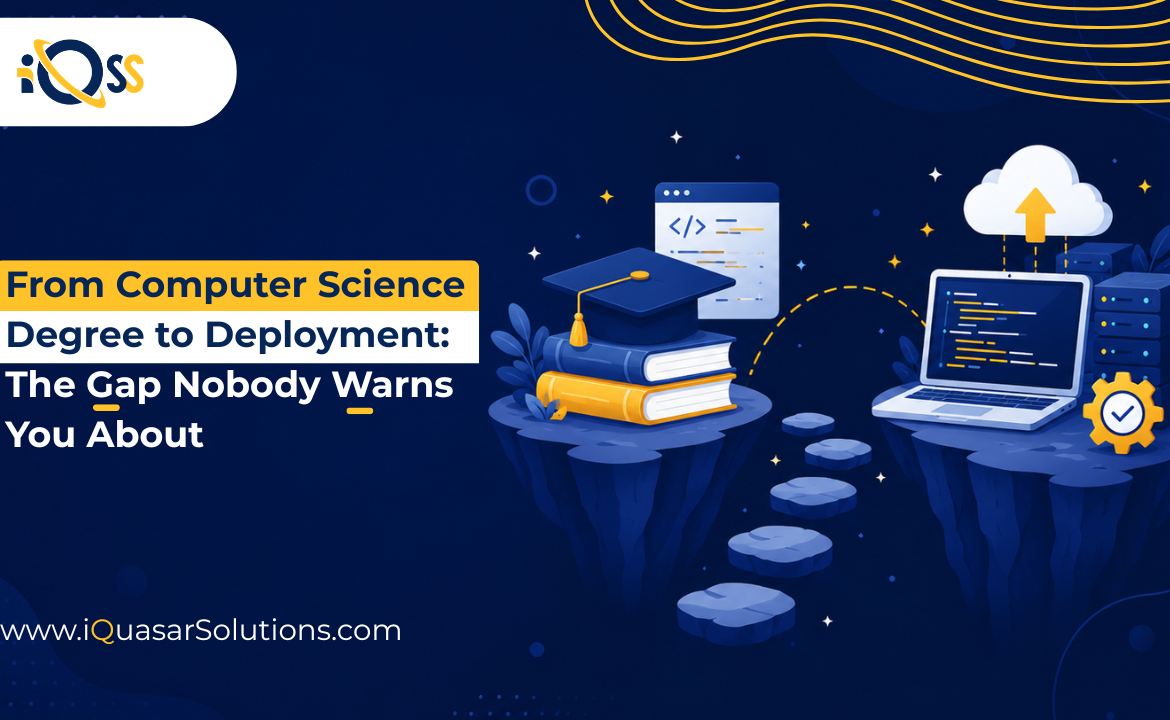
You earned a Computer Science degree – but are you truly ready for your first engineering job?
Moving from university to the workforce is a thrilling yet demanding experience for new graduates. Although a Computer Science degree equips you with essential skills in coding, algorithms, and theory, the professional world introduces entirely new demands. You are expected to manage massive codebases, work collaboratively, handle evolving project scopes, and create products that drive real business value. Recognizing these differences allows you to prepare effectively and transition into your first software engineering roles with confidence.
Understanding the Shift from College to Workplace
You must have often observed university projects usually come with clear requirements and objectives and often with a determined solution. On the contrary, the professional world is dynamic. Goals frequently shift; stakeholders often have different priorities, and you must evaluate multiple options to find the right path. Learning how to navigate uncertainty and make informed decisions becomes just as important as your technical skills.
College projects generally involve individual or small-group efforts, which includes informal communication with college mates and restricted learning. In the corporate world, your collaboration will be a team effort. You will work with diverse groups – including quality assurance, product management, design, and business stakeholders. Thus, in the corporate world your success depends not only on writing good code but also on communicating effectively, sharing ideas, and collaborating with others to achieve common goals.
What You Experience in Your First Engineering Job:
Working with Large and Existing Codebases:
One of the biggest surprises in your first engineering job is that you’ll rarely build applications from scratch. Instead, you’ll spend much of your time understanding and working with existing systems.
You’ll need to learn large codebases, understand past development decisions, and find effective solutions without impacting existing functionality. Along the way, you’ll gain valuable insights from experienced team members and develop the problem-solving skills needed to work in real-world software environments.
Learning Industry Tools and Development Practices:
Colleges emphasize theoretical computer science over using real-life scenarios. During your first job, you’ll become familiar with technologies such as Git, CI/CD pipelines, cloud platforms, ticketing systems, code review tools, and project management software. These tools are essential for building, testing, and deploying software efficiently in a professional environment.
Managing Responsibility in Production Environments:
In college, your focus will be to get good grades, and any mistake might cost you a bad score on your exam. However, in the corporate world mistakes can cost business operations, customers and company reputations. That’s why you’ll learn the importance of testing thoroughly, reviewing code carefully, asking questions when you’re unsure, and following established development processes.
Adapting to Communication and Feedback Culture:
College helps to learn basic technical skills but in the corporate world you will be required to learn new technologies, learn from mistakes and feedback. You’ll learn to view feedback and criticism as an opportunity to sharpen your skills and become a stronger engineer.
Bridging the Skill Gap from Campus to Corporate
Problem-solving:
In the corporate world, you’ll encounter challenges that don’t have textbook answers. Every day will provide you with new opportunities to analyze issues, evaluate options, and create practical solutions that balance business needs with technical requirements.
Debugging and System Analysis:
In the corporate world, a large portion of your time may be spent understanding why something isn’t working as expected. One of your most valuable skills will be learning how to investigate issues, identify root causes, and implement reliable fixes.
Time management and prioritization:
Unlike academic schedules, workplace priorities can change quickly. You’ll learn how to balance multiple tasks, meet deadlines, and focus on the work that delivers the required outcome.
Adaptability:
Technology evolves rapidly, and continuous learning becomes part of your career. Whether it’s a new framework, tool, or development practice, your ability to adapt will help you stay relevant and continue growing professionally.
Collaboration:
Great software is rarely built by one person alone. You’ll learn how to work effectively with people from different backgrounds, contribute to team goals, and build relationships that support both personal and professional growth.
Conclusion
A degree may open the door to an engineering career, but real-world experience turns potential into expertise. The transition from classroom projects to production environments is filled with challenges, discoveries, and growth. By providing mentorship, practical exposure, and meaningful opportunities, organizations can help the next generation of engineers build the confidence and skills needed to succeed.
At iQuasar, we are dedicated to empowering new graduates by providing them with the hands-on experience needed to thrive in the tech industry. When organizations invest in early-career engineers, they cultivate high-performing teams capable of driving innovation, tackling complex problems, and achieving long-term business growth.
Leave feedback about this